

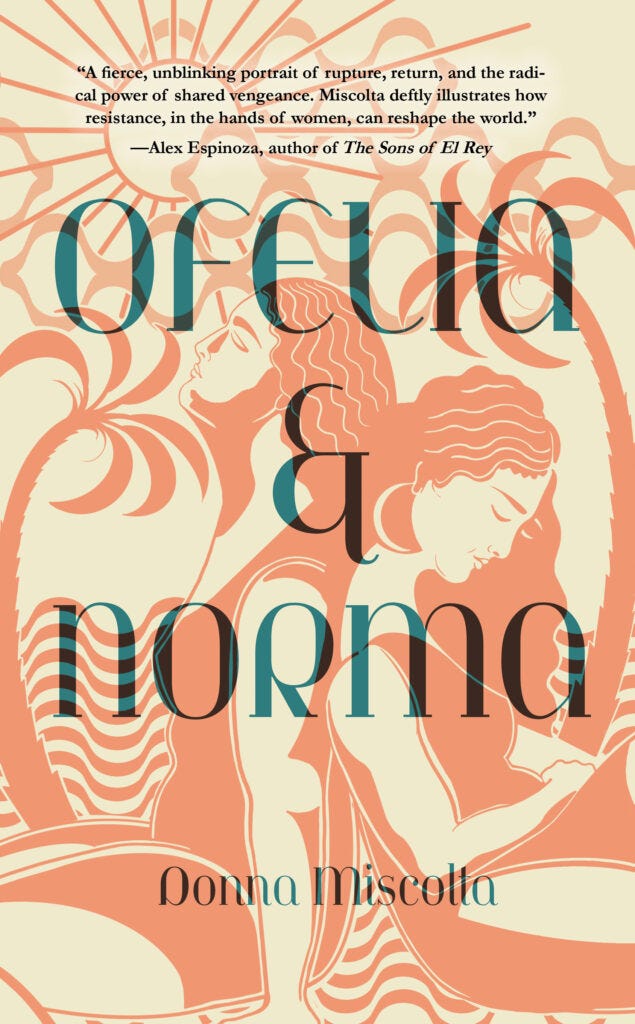
There’s something slightly unnerving about identical twins. Perhaps it’s the possibility of mistaken identity, or the fantasy that two people might somehow know what the other is thinking. Or maybe it’s simply the intensity of having spent your earliest years alongside somebody whose face, body and family history are almost indistinguishable from your own.
“I think people are fascinated by twins and revel in the potential for mistaken identity, practical jokes and telepathic communication,” the author Donna Miscolta says. “It’s also a particularly intense siblinghood, one I think, that we secretly wish for ourselves.”
In Micolta’s new book from Regal House Publishing, Ofelia and Norma, that intimacy is both a gift and a trap. The sisters begin the novel as inseparable, large-bodied twins whose closeness has protected them from much of the judgement directed at their bodies. But then something apparently quite innocuous happens.
“When one sister unintentionally changes her body by taking long, vigorous walks in the hills surrounding the campus while waiting for her twin to finish her classes, their physical likeness, the definition of their twinness, is diminished, and along with it their emotional bond,” Miscolta explains.
What follows is a novel in which the physical and emotional are constantly rubbing against each other. The sisters begin to pull apart just as they are reaching the age when almost everybody starts asking the same questions about identity and their place in the world.
“I think it’s natural for any person to want to discover who they are apart from their family and to establish themselves in the world, to feel themselves expand in new experiences and knowledge of the world and their relationship to it,” Miscolta says. “I imagine that twins are not exempt from this need. Maybe they are even more motivated to do so because their existence has been so intimately entwined with a physical double, when people have mistaken one for the other, or when people attribute a joke or opinion or personality trait to the wrong twin.”
For Ofelia and Norma, however, discovering an individual identity proves considerably more complicated than simply going their separate ways.
“As children, the twins were fine, or relatively so. It’s not that they were unaware of how their bigness made them conspicuous and drew unsympathetic attention. It’s that their deep sisterhood was a shield against the judgments of others and there was still the innocent shimmer of childhood that reminded them of the joy of just being.
“But post-adolescence, they are beginning to crave an identity apart from twin, or at least to know themselves as individuals, and once Ofelia’s body begins to change as a result of her daily hikes, the need to seek distance from one another becomes more urgent.”
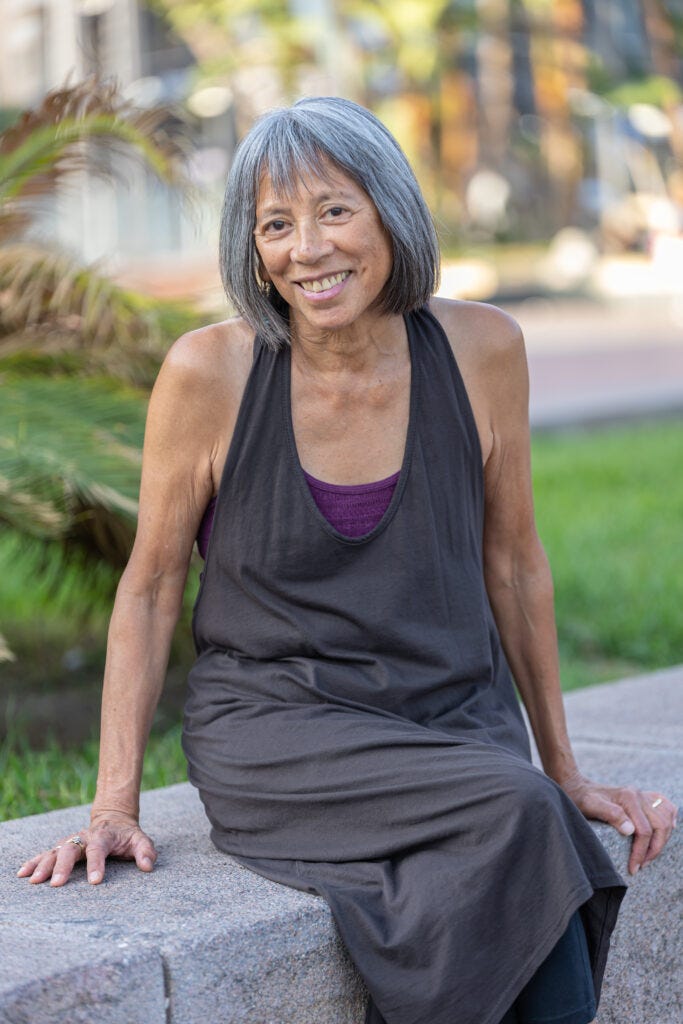
“But distance becomes estrangement since neither twin, though anxious to know how the other is doing, is willing to reveal her doubts and fears to the other. As they separately experience crises, they each alternately seek connection through new, if sometimes dubious, relationships and clarity of their own aspirations in moments of solitude.”
And beneath the twin story is another, even more uncomfortable question: what are women taught to believe about their bodies?
Ofelia and Norma is deeply concerned with body image and fatphobia but Miscolta is interested in more than simply showing the damage caused by judgement. “I wanted to ask: What are the assumptions and stereotypes regarding a certain body? Where do they originate, how are they propagated, and to what extent have we accepted or internalized them?
“Ofelia’s relationship to her body is complicated by her secret desire to be a chef, a maker of gastronomic masterpieces but not necessarily a consumer of them. Though she did have an appreciative palate, the greater thrill lay in the other senses - the olfactory, the visual, the tactile.”
Yet the image she imagines others seeing - a large-bodied chef surrounded by food - is enough to make her suppress the ambition. It’s one of the novel’s recurring tensions: the gap between what we want and what we imagine other people will think of us for wanting it.
“It’s hard to ignore others’ responses to our appearance or at least what we perceive as their response,” says Miscolta. “At a certain point we give in to those opinions. Though with time and much trouble, and, unfortunately sometimes trauma, we can throw off that scrutiny and judgment.”
Trauma, of course, becomes central to the second half of the sisters’ story. While Ofelia is struggling with her relationship with her changing body, Norma experiences a traumatic event at college. The two crises are private, but their consequences are shared. The sisters become increasingly unable to tell each other what is happening.
“The wedge begins to insert itself when Ofelia begins to lose pounds and inches from her hikes,” the author tells me. “Norma, feeling betrayed by this change and seeing it as almost a repudiation of their twinness, decides to continue her education in another city, away from Ofelia.
“The resentment and confusion engendered by this separation keeps each on guard against revealing too much of her life to the other. The person they have always confided in the most has become unavailable to them.”
Eventually, however, the sisters find their way back towards each other. And when they do, the novel takes a rather satisfying turn. There’s justice, there’s revenge and there’s the pleasure of watching two sisters decide that perhaps the world has not dealt with certain matters adequately.
“There are so many times in life that bad acts go unpunished. In fiction we can give our characters what they deserve.”
She is not particularly interested in pretending that fiction always has to behave itself.
“Does it sometimes defy expectations or probabilities? Does it raise questions of correctness or misguidedness? Yes, and yes. Sometimes you write to a conclusion because that’s where the emotional signposts lead.”
There is also considerable craft beneath the apparent simplicity of the story. The novel alternates between Ofelia and Norma but Miscolta deliberately gives them different narrative perspectives. Ofelia speaks in the first person; Norma’s chapters are written in the third person.
“My first draft had alternating first person perspectives,” Miscolta explains. “I did this because I wanted the closeness to the characters. I wanted to be the interiority of each character, her particular wants and foibles, her way of seeing the world and herself in the world. But even before I’d finished the draft, I knew that I’d have to differentiate the characters in a more mechanistic way, which is why I assigned the different points of view - first person for Ofelia and third person for Norma.”
The choice becomes particularly important in Norma’s chapters. “Third-person POV was important in her case because of the traumatic event she suffers. It was important to have a wider lens on that, for us to be witnesses.”
The origins of Ofelia and Norma go back considerably further than the novel itself. The sisters first appeared in a short story called “Strong Girls”, which was published in Miscolta’s earlier collection Hola and Goodbye. The story might easily have remained a story had an editor not spotted something larger lurking inside it.
“The idea came from an editor of a small press to whom I had submitted my story collection Hola and Goodbye,” Miscolta says. “She passed on that manuscript but said she had been particularly taken with the story about the twins and could see it as a novel.”
Miscolta was working on another novel at the time, so she put the idea aside. Then came an eighteen-day residency and an empty screen. “I didn’t think about it much until years later when I sat down in front of an empty screen at the start of an eighteen-day residency. It was time to conjure Ofelia and Norma from that story and give them more space, more life.”
That extra space has allowed the sisters to become part of a much wider conversation about women’s relationships with one another: the confidences, rivalries, betrayals and private histories that bind people together even when they are pulling apart.
Miscolta sees this as one reason these relationships remain such fertile territory for fiction. “Women share confidences. We tell each other our stories of who we were and of how we became who we are now and of what we want next. They are what bond us because they imply struggle and triumph, and sometimes betrayal. And the more stories we hear, the more we understand ourselves.”
There is another dimension to Miscolta’s interest in belonging, however, which has become particularly relevant to The Madrid Review since her move to Spain.
Miscolta relocated from Seattle to Málaga in 2023. As we discussed in our earlier conversation here on Substack, Spain has given her a different vantage point from which to consider identity, nationality and the question of where - and whether - we belong.
Her own family origins are Filipino and Mexican. She grew up in San Diego, in the south-western corner of the United States, and says that the history she was taught did not adequately reflect the history of families and communities like hers.
“There are many reasons why a person might not feel a sense of belonging. Race and colour are among them,” she says. “My family origins are Filipino and Mexican. I was born and grew up in the very southwestern corner of the United States, in San Diego, California.”
“Learning a history in school that does not include the migratory waves and cultural and historical contributions of your family and community is as exclusionary as the actual laws that had at various times banned entry to the country, redlined neighbourhoods, and prohibited interracial marriage.”
“There’s a clear message as to who does and doesn’t belong.”
What she says next could almost serve as an epigraph for the novel - or perhaps for the experience of being an outsider anywhere: “You either get used to it, learn to crash the party, or make your own party.”
Living in Spain, she says, has changed her perspective, partly because she no longer feels that belonging is something she is obliged to demand. “I love Spain but I’m not Spanish and never will be. I’ll always be an extranjera even when I become a permanent resident. That is my identity here.”
There is, unexpectedly, freedom in that.
“I don’t have to try to belong in the way it felt urgent and owed to me in the US, and that provides a sense of liberation and ease.”
Today, Ofelia and Norma leaves the world of its author and begins its life with readers.
It is, on the surface, a story about two sisters who stop looking alike. But underneath that is a more universal story: what happens when the person who has always helped define you becomes the person you need to move away from; what happens when other people’s ideas about your body become part of your own internal voice; and what happens when, after all the separation, anger and damage, you decide that the relationship is worth finding again.
For Miscolta, perhaps, it is also a story about the strange freedom that can come from accepting that belonging does not always mean becoming indistinguishable from everyone around you.
Sometimes it means knowing exactly where you stand — even if, as an extranjera, you are standing slightly outside the room.
What a great interview and book review; I can’t wait to read this novel. I appreciated Donna’s reflections on choosing point-of view for her characters, that always bedeviling decision for a writer. And this statement is so true to my experience: “Women share confidences. We tell each other our stories of who we were and of how we became who we are now and of what we want next. They are what bond us because they imply struggle and triumph, and sometimes betrayal. And the more stories we hear, the more we understand ourselves.”